
USING DIALECT IN FICTION

Dialect is language particular to a region—think Louisiana with Creole, Yat, Cajun (which is a blend of Spanish, French, and influences from the south), New York (which, well, is characterized by a punchy delivery, dropped r’s (non-rhoticity, sort of similar to Boston’s), fast speech, dropped g’s (“I’ve been coughin’,” “he saw nothin’”, Yo, Jimmy’s not gonna like that), the Texas Twang (“y’all better shut that laht”, “ain’t that a beautiful dray-us” (the Texas diphthong is where one-syllable becomes two) (also, that’s only for West and North Texas, as there are, it is said, 9 different accents, including Deep South and Tejano), and if you’re a fan of Peaky Blinders like I am, the Shelby family uses a version of “Brummie,” an accent from Birmingham, or the West Midlands of England, though native Birminghamers (Brummies) say it’s a watered-down version of their actual dialect. If you’ve seen the show, you know there’s a blend of Brummie and Scouse, which is from Liverpool, and other Cockney, which is a blend of other dialects. In Peaky Blinders, words are smushed together, slurred, voices rise at the end of sentences, the “uh” is used often, “but” sounds like “put,” and so on. And what do all these dialects do for fiction? Well, if you're using dialect in fiction, you should know what it is and how to use it appropriately. Let’s take a look at a few examples.
One of the strongest, and frankly most difficult novels I’ve ever read was Trainspotting, by Irvine Welsh. Welsh is a Scottish novelist, screenwriter, short story writer and filmmaker. Trainspotting, written in a thick Irish brogue, uses phonetic spelling throughout the novel (if you’ve seen the movie, which was great, you know exactly what I’m talking about, in terms of trying to figure, audibly, what the characters are saying, just like readers had to figure out what Welsh’s characters were saying in the novel). But it’s like a puzzle, in my view, deciphering the lingo. A puzzle that, once you see it, once you understand it, you cannot not see it. The dialect, the jargon, becomes part of the beauty (and, for many, the enjoyment) of the book. Anyone, with enough knowledge, enough tenacity, enough persistence and time, can dive into creating words and sentences, chapters and whole novels, either using real dialect or invented dialect, to write their own novels that differentiate them from everything else out there (think Room by Emma Donoghue, which is told through the eyes and words of five-year-old Jack, who “speaks” and sees the world in a limited way with limited vocabulary. Perhaps Room is narrated in a style rather than dialect, in the social focus of a sheltered child who doesn’t know the outside world or words to communicate what he doesn’t know, but for me it’s also an expression of Donoghue’s having been born in Dublin and living in London, Ontario, which has its own distinct Southwestern Ontario accent.
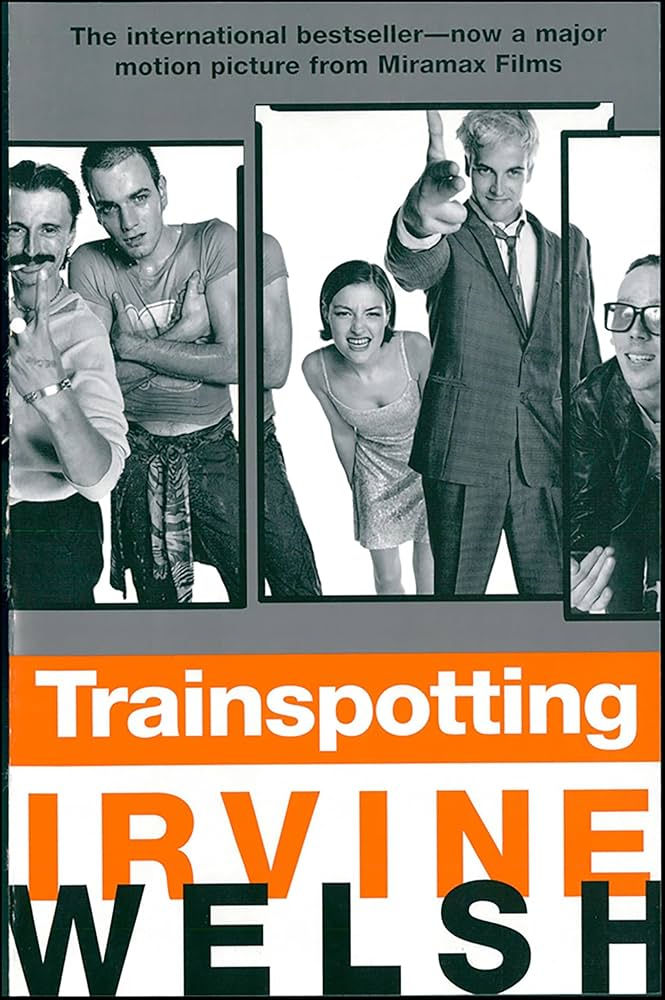
Here’s the first few lines of Trainspotting:
“The sweat wis lashing oafay Sick Boy; he wis trembling. Ah wis jist sitting thair, focusing oan the telly, tryin no tae notice the cunt. He wis bringing me doon. Ah tried tae keep ma attention oan the Jean–Claude Van Damme video. As happens in such movies, they started oaf wi an obligatory dramatic opening. Then the next phase ay the picture involved building up the tension through introducing the dastardly villain and sticking the weak plot thegither. Any minute now though, auld Jean–Claude's ready tae git doon tae some serious swedgin.– Rents. Ah've goat tae see Mother Superior, Sick Boy gasped, shaking his heid.- Aw, ah sais. Ah wanted the radge tae jist fuck off ootay ma visage, tae go oan his ain, n jist leave us wi Jean–Claude. Oan the other hand, ah'd be gitting sick tae before long, and if that cunt went n scored, he'd haud oot oan us. They call urn Sick Boy, no because he's eywis sick wi junk withdrawal, but because he's just one sick cunt.– Let's fuckin go, he snapped desperately.”
It’s hard to get at first, but not for long. That’s the beauty of well-done dialect in literature.
Another novel which uses effective dialect (which while regional, perhaps, just comes off as a style choice for me) is A Clockwork Orange, by Anthony Burgess. Orange uses “Nadsat,” which uses biblical phrases and is a blending of Russian and English with a rhyming Cockney slang to it. Here’s most of the first paragraph of A Clockwork Orange:
“'WHAT'S it going to be then, eh?'
There was me, that is Alex, and my three droogs, that is Pete, Georgie, and Dim, Dimbeing really dim, and we sat in the Korova Milkbar making up our rassoodocks what to do with the evening, a flip dark chill winter bastard though dry. The Korova Milkbar was a milk-plus mesto, and you may, O my brothers, have forgotten what these mestos were like, things changing so skorry these days and everybody very quick to forget, newspapers not being read much neither. Well, what they sold there was milk plus something else. They had no licence for selling liquor, but there was no law yet against prodding some of the new veshches which they used to put into the old moloko, so you could peet it with vellocet or synthemesc or drencromor one or two other veshches which would give you a nice quiet horror show fifteen minutes admiring Bog And All His Holy Angels And Saints in your left shoe with lights bursting all over your mozg.”
In this scenario, “Horror show” means good, “droogs” are friends, “mesto” means place, “moloko” means milk, “peet” means to drink, “vellocet” is a drug, “synthemesc” is drug, and “drencomor” or drencom, is, again, a drug, and “rassoodock” means mind. Clearly there’s a certain something on Burgess’s “rassooock” as he wrote the novel. But what does it all mean, an author’s decision to use dialect in their writing?

And who can forget the language of Alice Walker’s The Color Purple, which is written in a Southern American dialect, black folk language, also known as AAVE (African American Vernacular English), which is characterized with double negatives, contractions like “ain’t,” and other conventions used to create that authentic voice we hear throughout the novel. The novel’s narrator is Celie, a black woman living in poverty, and it is written in an epistolary style (letters to God and Nettie, her sister):
“You better not never tell nobody but God. It’d kill your mammy.
DEAR GOD,
I am fourteen years old. I am I have always been a good girl. Maybe you can give me a sign letting me know what is happening to me.
Last spring after little Lucious come I heard them fussing. He was pulling on her arm. She say It too soon, Fonso, I ain’t well. Finally he leave her alone. A week go by, he pulling on her arm again. She say Naw, I ain’t gonna. Can’t you see I’m already half dead, an all of these chilren.
She went to visit her sister doctor over Macon. Left me to see after the others. He never had a kine word to say to me. Just say You gonna do what your mammy wouldn’t. First he put his thing up gainst my hip and sort of wiggle it around. Then he grab hold my titties. Then he push his thing inside my pussy. When that hurt, I cry. He start to choke me, saying You better shut up and git used to it.

But I don’t never git used to it. And now I feels sick every time I be the one to cook. My mama she fuss at me an look at me. She happy, cause he good to her now. But too sick to last long.”
Now, whether or not you like the epistolary style of the novel (I’m not a big fan of epistolary novels, but Purple definitely is one I like), Walker knows what she’s doing). Walker explores themes of domestic abuse (which, for me, was the most powerful part of the novel and, subsequently, the movie (Albert, played by Danny Glover does an incredible job of being an abusive tormentor of Celie), as well as themes of racism, spirituality, self-discovery, empowerment, and more. The dialect of the characters is pitch perfect without being sentimental. The novel takes place in Georgia, and, based on the dialect and the reality of the times for African Americans, almost comes off as fiction based directly of nonfiction. As an FYI, the term “African American” was first introduced into English, apparently, in a sermon in Philadelphia in 1782, but not popularized in literature in 1835, with the late Reverend Jesse Jackson bringing it back into use between 1988 and 1989. Afro-American was used between the 1960s and the 1990s.
The list of novels and fiction that utilize dialect are innumerable, and point to the importance authors put on the written and spoken reality, however altered from the original, of the “place” and “setting” of their stories. Some novels that are known for their dialect include:
Wuthering Heights by Emily Brontë (thick Yorkshire dialect and standard English)
Their Eyes Were Watching God by Zora Neale Hurston (Southern Black dialect)
Adventures of Huckleberry Finn by Mark Twain (Missouri negro dialect and Mississippi Southwestern dialect, among others
Finnegan’s Wake by James Joyce (modernist literature with portmanteaux, some incomprehensible gibberish, linguistic hybrids, and more)
Sinking of the Odradek Stadium by Harry Mathews (a language called Pan, in an epistolary style)
USING DIALECT IN FICTION
Whatever dialect you choose to use, make sure you’re doing it justice. Unless you’re from the town or city or state or region that you’re writing about, and so know, firsthand, the details and words and accents and how people speak, make sure to do your research. Be thorough. The last thing you want to do is write a novel in Jamaican Patois and get everything wrong, because you’re translating everything literally, ignoring the cadence or common phrases for things and situations, and so on. Get it right, or your readers, at least the ones in the settings you’re using, will know you don’t know what you’re talking about. No one likes to be represented incorrectly in literature. And you, as the author of the novel or short story or whatever, should show the required respect to said people, at least if you want to have the appropriate credibility for the novel you’re writing or have already written.
Cully Perlman is author of a novel, THE LOSSES. He can be reached at Cully@novelmasterclass.com
*Any commissions from affiliate links are used to keep this blog free to you, my fellow writers. If you can contribute somehow, feel free to purchase a coffee or something off one of the links on the site. Thanks!


Comments